


What You Need to Know
The Joint Admissions and Matriculation Board (JAMB) has officially addressed recent rumors claiming that undergraduate students are prohibited from registering for the 2026 Unified Tertiary Matriculation Examination (UTME).
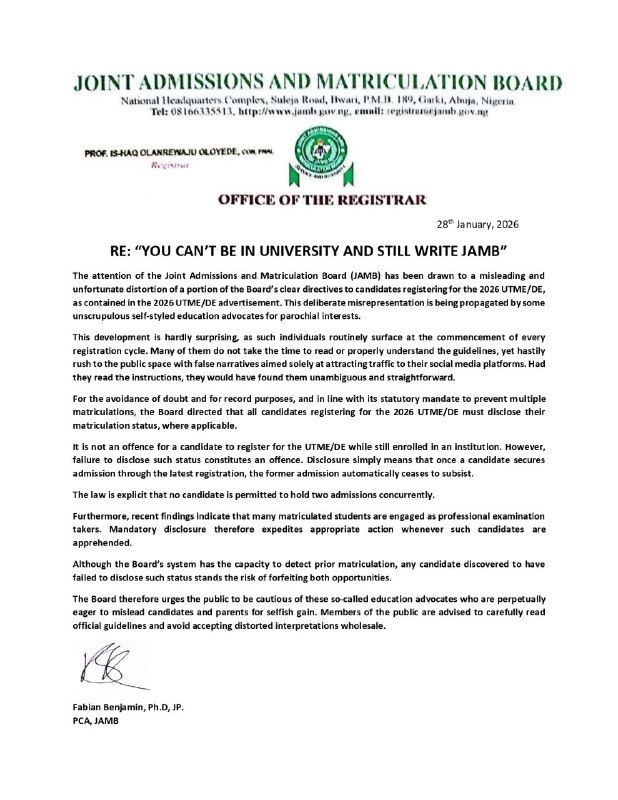
In a statement released on January 28, 2026, JAMB debunked the claims as misleading and deliberately distorted, indirectly criticizing education advocate Alex Onyia for misinterpreting its guidelines. This clarification comes amid growing confusion over the 2026 UTME/Direct Entry (DE) registration process, which began in late January 2026.
Here’s a breakdown of the facts, the controversy, and what it means for candidates.
The Controversy: Alex Onyia’s Claims Spark DebateEducation activist and CEO of Educare, Alex Onyia, took to X (formerly Twitter) to highlight what he described as a harsh new policy.
In a widely viewed post (over 200,000 views), Onyia argued that JAMB’s directive requiring candidates with existing admissions to “terminate” them before re-registering was unfair. He gave an example:
“Imagine a student currently studying Botany, but who now wants to pursue Medicine. Under this new policy, the student must: First lose their current admission, then register for JAMB, then hope they meet Medicine cut-off.”
Onyia’s post amplified concerns among students seeking to change courses or institutions, framing the guideline as a blanket ban on undergraduates registering for UTME.
JAMB’s Official Response: No Ban, But Full Disclosure Required JAMB swiftly responded, stating that no policy bars enrolled undergraduates from registering for the 2026 UTME or DE.
The board emphasized that the requirement is simply for transparency:
- Candidates must disclose their current matriculation status (if already admitted to a tertiary institution) during registration.
- Failure to disclose is considered an offence, which could lead to:
- Nullification of UTME registration
- Revocation of existing admission
- Potential legal sanctions
JAMB explained that this measure prevents multiple simultaneous admissions and combats examination malpractice, as some past offenders were already enrolled students attempting to game the system.
The board described the reports as “misleading and deliberately distorted” interpretations by “self-styled education advocates.”
It warned candidates and parents to rely only on official JAMB channels, not social media sensationalism.
Why This Matters for 2026 UTME Aspirants
The 2026 UTME registration is ongoing, and accurate information is crucial to avoid disqualification.
Key points from JAMB’s guidelines include:
- Eligibility: Candidates must be at least 16 years old by September 30, 2026 (for general admission consideration).
- Registration Process: Use NIMC-linked data, create a profile early, and register at approved CBT centres. Cashless payments are mandatory to prevent exploitation.
- Disclosure Rule: Truthfully declare prior admissions—it’s not a ban, but hiding it is risky.
- Purpose: Ensures the admission system remains fair and prevents abuse.
This policy aligns with JAMB’s long-standing efforts to regulate admissions strictly, especially after controversies in previous years (like the 2025 UTME glitches and mass low scores, where Onyia also advocated publicly and was even invited to a review panel).
Advice for Candidates If you’re an undergraduate considering re-taking the UTME (e.g., for a course change like switching from Botany to Medicine), you can register just declare your status honestly.
Consult official JAMB sources or accredited centres for guidance.Avoid relying on unverified social media claims. JAMB’s portal and verified statements are the most reliable.
This episode highlights the importance of clear communication in Nigeria’s education sector and how quickly misinformation can spread on platforms like X